October 31, 2024
/
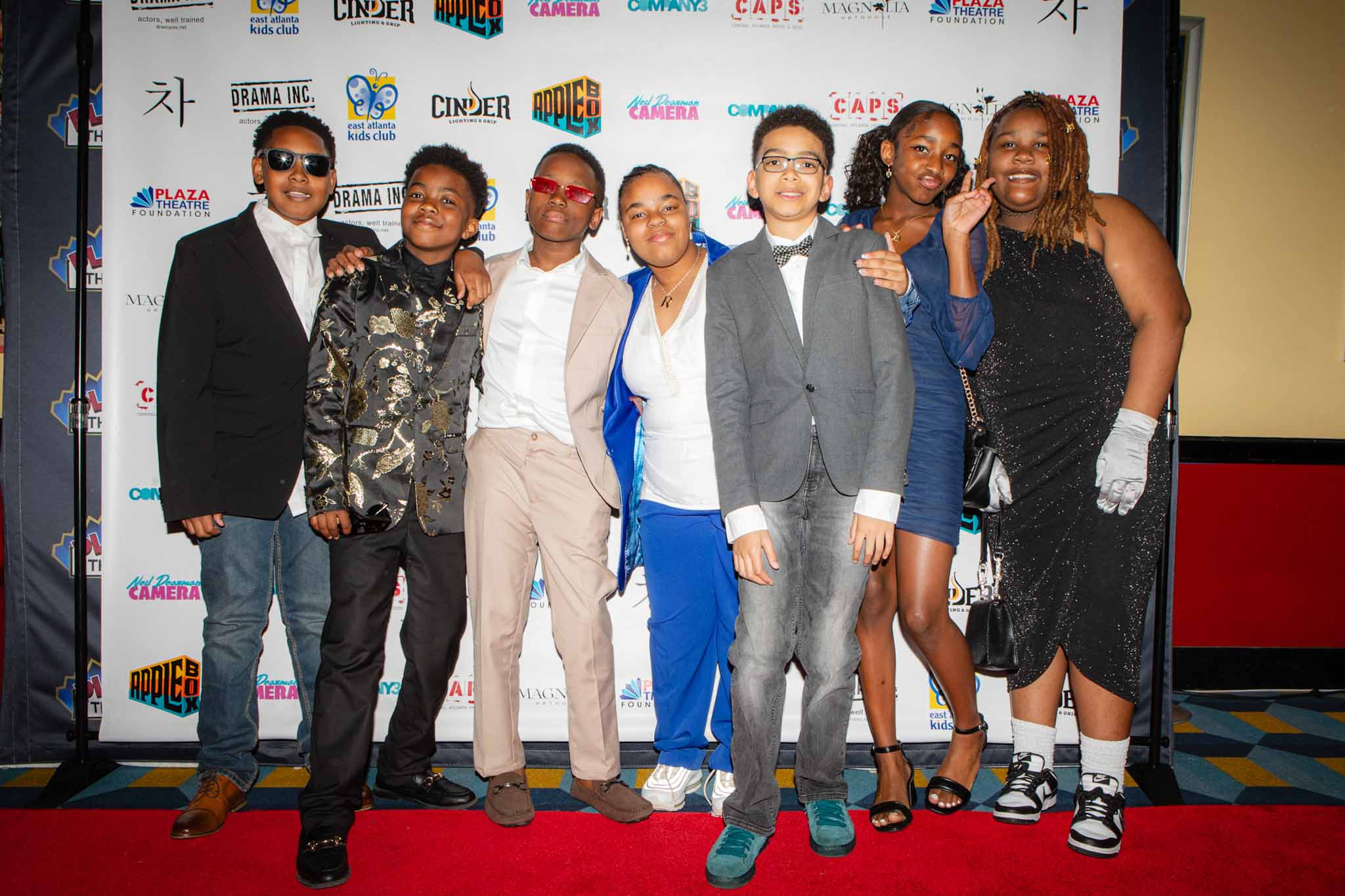
Pictured: Students from East Atlanta Kids Club pose during an event
by Community Foundation staff
In September, the Community Foundation for Greater Atlanta, in collaboration with Step Ahead Scholars and State Farm, provided a grant to East Atlanta Kids Club (EAKC) to revamp their podcast studio. Recently, we sat down with Ryan Downey, executive director at EAKC, to talk about the new studio, how growing up on Atlanta’s south side informs his work, and how we, as a community, can continue showing up for youth.
Community Foundation: You worked with young people and teenagers at Year Up for almost a decade before coming to EAKC and were inspired to work with kids so you could get ahead of some of the things you saw as challenges for young adults. What were some of these challenges?
Downey: Year Up wasn’t my first time working with Opportunity Youth, but it exposed me to the greatest range of experiences – both positive and challenging. I worked with young adults between the ages of 18-24, and I sat across from them while they shared intimate stories of trauma, loss and persistent barriers to their success. The challenges that our young people faced centered on healthcare or lack thereof, housing instability, food insecurity, and entrenched beliefs about their value and potential.
At EAKC, we can get ahead of some of these barriers, and we can refer to partners to address others. The most important thing we can do, though, is to expose our youth to possibilities and to a host of caring adults who are willing to support them in reaching their aspirations. If you have that as a kid, the rest often falls into place, and you develop a resilience that lends toward positive outcomes.
Community Foundation: You’re from Peachtree City. In your LinkedIn bio, you state that, you were “a kid that needed a program like East Atlanta Kids Club in a community that didn’t always imagine there were many kids like me among them.” Talk about how that experience informs your work at EAKC and how we, as a community, can continue to show up for youth.
Downey: As a kid, I felt like I was seen by a handful of caring adults, but I also felt like the challenges that I faced were largely invisible, or at least unimportant, to both my peers and the broader community. Affluent communities sometimes feel like spaces where everyone is “waiting out” the last few poorer folks when you are one of those kids. Increasingly, many of our in-town Atlanta neighborhoods feel that way, and it shows up in the rhetoric of the community (the topics selected in community meetings where adult stakeholders gather, the tone and narrative motifs that bind local social media groups together, and the priorities of the institutions that shape youth culture in each community—schools and community parent groups, for example).
As someone leading a community-based nonprofit in a part of town that is experiencing rapid economic development, I see our kids getting left out of the conversation. Neither they nor their parents are often in the rooms and meetings (mostly at night, when working parents are less likely to be civically engaged) where hyperlocal community matters get discussed and resolved. Kids in southeast Atlanta aren’t as often the focus of place-based philanthropy and larger scale investment in equitable opportunity as they may be in other areas of the city, either. Truly, it feels like we are waiting them out.
At EAKC, we center our programs on the needs and interests of our kids and families, and given our larger responsibility for managing a City of Atlanta facility for the whole community, we have a unique position where we can advocate for our youth and create strong ties between folks from disparate backgrounds in this shared public space. It is important for the community to show up for youth in the rooms that they (and their parents) are rarely invited into. These include spaces where policy is set and funding decisions are made. On a community level, these include the community meetings where concerns about trees, municipal ordinances, variances for property improvements, and parking suck all of the air out of the room, and parents and kids are perceived as an afterthought when it comes to the health of the community by many folks in attendance. We can and must continue to invest in human services that address our growing crisis in terms of adult homelessness and emergent mental health needs in our business districts and every other human service need that is pressing and persistent, but if we don’t have enough foresight to invest in our youth at the same time, we are punting these problems to the next generation of Atlantans.
Community Foundation: How is EAKC working to ensure that students you serve will have a shot at economic mobility?
Downey: Often, we want to tie mobility to education or to workforce development interventions that build skills tied to in-demand careers. So, we can talk about our app development partnership with Tech Corps, or our podcasting, or our STEAM programs, or our sports-based programs as opportunities for exposure to new skills and experiences. What we are missing when we look at the content of those programs as the primary lever of growth for our young people is that it’s the caring adults that they will anchor to and learn from. Our kids won’t talk about learning how to play tennis 20 years from now. They will talk about how Coach Daisha was a relatable role model who took them aside and told them something positive about themselves at a moment when they were feeling particularly adrift emotionally.
They won’t talk about how the work of a specific artist resonated with them 20 years from now. They’ll talk about how having aspirational peers from Spelman leading Black Kid Art showed them a pathway for Black youth to be proud of their cultural heritage, entrepreneurial and socially engaged all at the same time. We are in the business of surrounding our kids with caring adults who are experts at their craft and who have meaningful shared experiences with our kids and a willingness to empower them to realize their worth.
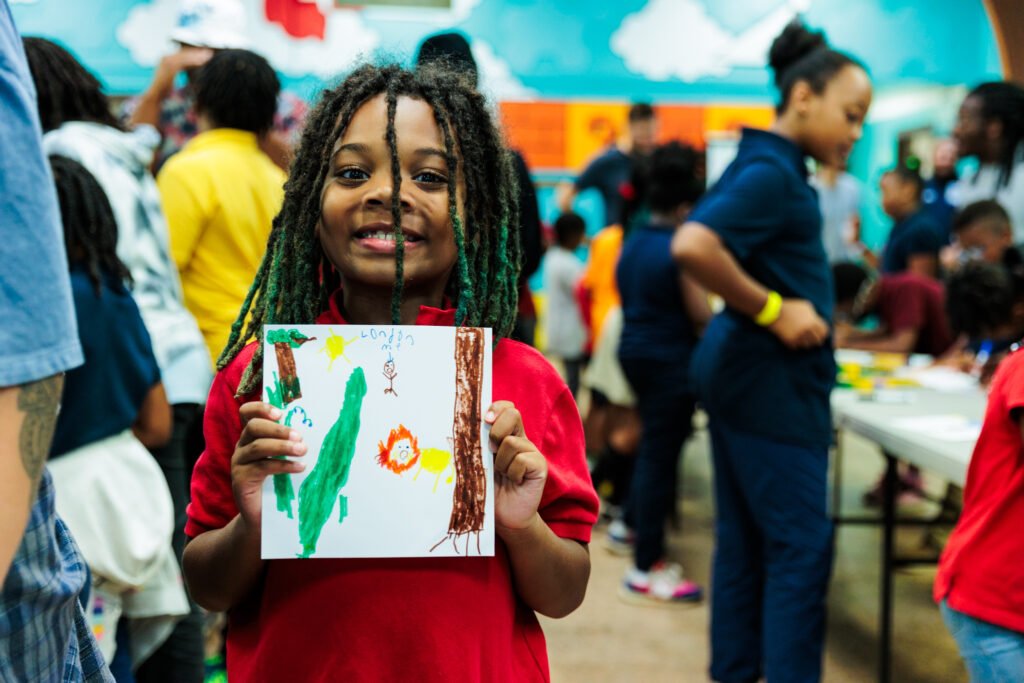
East Atlanta Kids Club student proudly displays his artwork
Community Foundation: EAKC has a kid’s podcast – Kidz Corner Podcast. What was the inspiration for this podcast, and what will the recent grant from the Community Foundation for Greater Atlanta, State Farm and Step Ahead Scholars mean for the show and the podcast team?
Downey: Our Program Manager, Dannie Erwin, deserves all of the credit for this program. It’s a passion project for her, and our initial spend on equipment to make it happen was modest. This recent grant of $5,000 has empowered us to procure professional tables (with cable management, and mic arms, and built-in power outlets), new chairs, new headphones, and some sound baffling materials. These improvements are important for the sound quality of the show, and they certainly kick our professionalism up a notch, but the more important thing is that they are the visual, concrete signifier of our care and pride for our youth. They signal to them that they are worthy of investment and having the right tools to hone their craft.
“Affluent communities sometimes feel like spaces where everyone is “waiting out” the last few poorer folks when you are one of those kids. Increasingly, many of our in-town Atlanta neighborhoods feel that way, and it shows up in the rhetoric of the community.” – Ryan Downey, executive director at EAK
To learn more about how you can support East Atlanta Kids Club, contact Ryan Downey at rdowney@eastatlantakids.org or 312.451.1529.
Categories
- Arts, Culture and Creative Enterprises12
- Book Club26
- Community110
- COVID-1934
- Donor Stories57
- Events32
- Great Grant Stories65
- Higher Ground169
- Housing and Neighborhoods29
- Impact Investing37
- Income and Wealth19
- Media22
- News161
- Nonprofits33
- Philanthropic Resources181
- Place-focused8
- Power and Leadership9
- Press Releases100
- Publications87
- TogetherATL26
- Uncategorized426