
June 5, 2023
/
By Dominque Feloss, program associate, Income & Wealth and Arts
Atlanta is a prime location for job seekers and entrepreneurs alike, with a career growth rate that surpasses the national growth rate by .3%. Atlanta is home to a flourishing economy and ample opportunities for career advancement but access to those opportunities is inequitably distributed. Last year, Money Magazine dubbed Atlanta “the best place to live in the U.S.” in large part due to its strong and growing job market. However, Atlanta still has the highest income inequality in the nation.
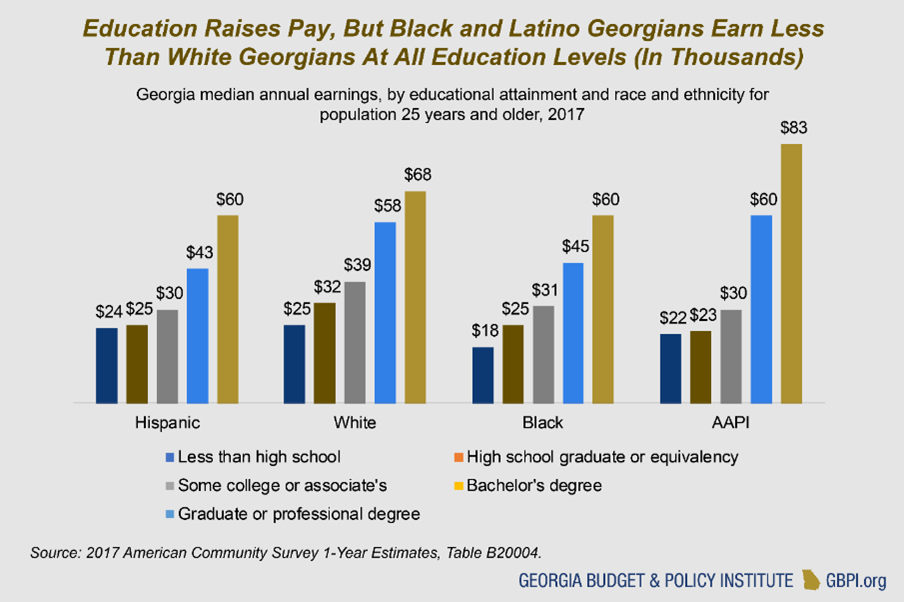
While recent unemployment rates are low in Atlanta, the unemployment rate for Black workers is almost double that of white workers. For workers who are employed, racial and gender wage gaps persist. On Average, Black women were paid 58% of what non-Hispanic white men were paid in 2020. The vast pay difference between workers who identify as Black, Indigenous, and other people of color, and white workers is astronomical and contributes to both income inequality as well as wealth disparities. Over the course of their career, wage disparities cost Black women more than $800,000 when compared to white men.
Black people, and particularly Black women, are among the most educated groups in the United States, with a higher percentage of bachelor’s and advanced degrees than any other racial or ethnic group, according to recent statistics. Despite having these qualifications, why are there huge economic gaps between white and Black households? Why does the unemployment rate of Black individuals tower over white people even though Black women are the most qualified in the current job market? Discrimination in the labor market is a huge piece of the puzzle. While there are many factors that come into play, such as widespread residential segregation, historically racist systems, and the over policing of Black neighborhoods which leads to elevated incarceration rates, it’s clear that not everyone in our region is benefiting equally from its economic growth and opportunities.
Taking all obstacles into consideration, what steps can we take to ensure that all marginalized people of Atlanta have access to equitable economic opportunity?
Making sure that all residents of Atlanta have access to the opportunities its economic growth brings is our region’s moral imperative, and it’s going to take all of us. The solution lies with equitable opportunity, which produces a significant reduction in disparate circumstances. Increased access to high quality job opportunities allows for financial security and wealth building. Increasing access results in healthier and more inclusive work environments, healthier communities, and a better quality of life for all residents.
Here are some things each of us can do within our companies and workplaces to ensure access to high quality jobs for all:
- Engage in Diversity, Equity, and Inclusion (DEI) training and best practices. DEI training aims to help organizations become more inclusive by providing employees with the tools and knowledge they need to create a more welcoming and equitable work environment. This can include things like cultural sensitivity training and how to recognize and address discrimination in the workplace. By increasing access to DEI training, companies can help ensure that everyone has an equal opportunity to succeed in their careers. It’s designed to foster an inclusive culture that celebrates differences and encourages employees to build relationships with colleagues from different backgrounds (Eraina Furgoson, 2023).
- Encourage your company to implement skills-based hiring, where appropriate. This ensures that formal degrees are not a barrier for folks who are qualified and have the ability to be successful in a position, and that degrees are only required for positions for which they absolutely must be.
- Encourage your company to be transparent about salaries, to make sure that everyone is being paid fairly, and offer benefits that create wealth-building pathways. This can include displaying salary ranges on job descriptions, having transparent career pathways and opportunities for staff across the organization, and offering benefits like health insurance, ample paid leave, and retirement plans.
- Get involved in the community. Connect with local schools and nonprofits who serve youth and young adults, the workforce of the near future. Encourage your company to offer internships, formal mentorship programs, and other meaningful connection points.
Photo credit: Photo by Marten Bjork on Unsplash
Categories
- Arts, Culture and Creative Enterprises12
- Book Club26
- Community110
- COVID-1934
- Donor Stories57
- Events32
- Great Grant Stories65
- Higher Ground169
- Housing and Neighborhoods29
- Impact Investing37
- Income and Wealth19
- Media22
- News161
- Nonprofits33
- Philanthropic Resources181
- Place-focused8
- Power and Leadership9
- Press Releases100
- Publications87
- TogetherATL26
- Uncategorized426