June 18, 2025
/
By Nikonie Brown-McManus, digital content associate
Rap is a cornerstone of Black music and culture, rooted in storytelling, resistance and rhythm. But for Soul Food Cypher, freestyle rap is more than entertainment. It’s a tool for healing, connection and transformation. As we celebrate Black Music Month, we spoke with Alex Acosta, founding executive director of Soul Food Cypher, to explore how spontaneous rhyme can move hearts, shift narratives and uplift entire communities.
How did Soul Food Cypher get started and what inspired its creation?
In 2011, I began mentoring youth at the Whitefoord Intel Computer Clubhouse in East Atlanta, teaching media skills. But the real connection didn’t come through cameras or software. It came through freestyle rap. Cyphers would break out, and inside those circles, the youth opened up. They spoke about abuse, violence and their realities, but also expressed hope and dreamed out loud. That’s when I realized the cypher was a deeply powerful space.
At the same time, I was freestyling with close friends and wondered: what would it look like to create an intentional, nurturing space where people from all walks of life could come together – not to battle, but to build? To sharpen their craft, express themselves and be seen? That idea led me to write a proposal to WonderRoot, a community arts center in East Atlanta.
The first time I stepped into WonderRoot’s basement, I had a vision. It felt like the perfect space for an underground hip-hop event. I always say there’s something special about Georgia’s red clay. It holds stories, rhythm and spirit. Just like the Dungeon Family came up out of the basement of Rico Wade’s mother’s home, we got our start in the basement of WonderRoot. That red clay runs through all of it.
From the very beginning, we knew we were creating something powerful.
Take us back to one of your earliest cyphers. What was the energy like and what did it teach you?
The first cypher taught me a lot, both artistically and spiritually. Going in, I assumed most people would come with prewritten rhymes, what we call “writtens,” but what happened in that basement blew me away. The level of improvisation—the raw skill and openness—was astounding. Most of the MCs preferred to freestyle. They wanted to speak from the heart, in the moment. That showed me two things: the talent in Atlanta runs deep, and there’s a much larger appreciation for true freestyle than I realized.
It also revealed Atlanta’s beautiful diversity. Not all the MCs sounded alike. They came from different parts of the city and the world – Black, white, Middle Eastern, Latino and beyond – all coming together through hip-hop. Atlanta has always been a crossroads of sound, style, and identity, and that night reminded me that hip-hop, at its best, holds space for all of that.
But there was another layer too, one we didn’t fully understand until later. That night, February 26, 2012, was also the night Trayvon Martin was murdered. We didn’t know it at the time, but it became a turning point for the country. While the world was being reminded that we were not living in a post-racial America, our cypher embodied the ideals this country claims to stand for: unity, expression and freedom.
The cypher is a democratic space. There’s no stage, no hierarchy. Everyone’s on eye level. Everyone has agency. And instead of insults, we use our words to connect, to build and to share. That night showed me what was possible. Not just for MCs, but for the culture.
How does freestyle rap serve as a tool for personal or community transformation?
I like to say: freestyle rap is one of the greatest displays of faith. To stand up and improvise on the spot, trusting that what you create will rhyme, stay on beat, make sense and resonate, that takes real belief in yourself. It takes confidence, clarity and self-knowledge. Perfecting this craft is about finding your voice, finding your spirit and putting faith into motion.
On a community level, I draw inspiration from Rakim, who famously said, “MC means move the crowd.” We’ve taken that concept and expanded it: MC moves the community. MCs are not just performers; they’re representatives of where they come from. One of the first and most important questions we ask any MC is, Where you from? Because that place carries history, heritage, style and cultural markers that shape who they are. Through their voice, MCs can shine light on issues affecting their communities, bring awareness, and spark real change.
One Atlanta legend who embodies this is Killer Mike. His music goes beyond bars. It’s activism and storytelling wrapped in rhyme. He speaks truth to power, highlights urgent social issues, and mobilizes communities through his voice and actions.
You see this kind of transformation beyond Atlanta too. In Newark, Dupré “DoItAll” Kelly of the platinum-selling group Lords of the Underground was elected to city council. And Mayor Ras Baraka, son of the poet Amiri Baraka, came out of the spoken word and hip-hop tradition as well. These are MCs whose influence moved beyond the stage and into policy, leadership, and structural change.
At the end of the day, freestyle rap is faith made audible. It’s confidence in your voice, connection to your roots, and the power to transform not just yourself, but your entire community.
What makes a Soul Food Cypher event different from a typical rap performance or battle?
At Soul Food Cypher, we curate experiences rooted in our core values: Respect, Responsibility, and Knowledge.
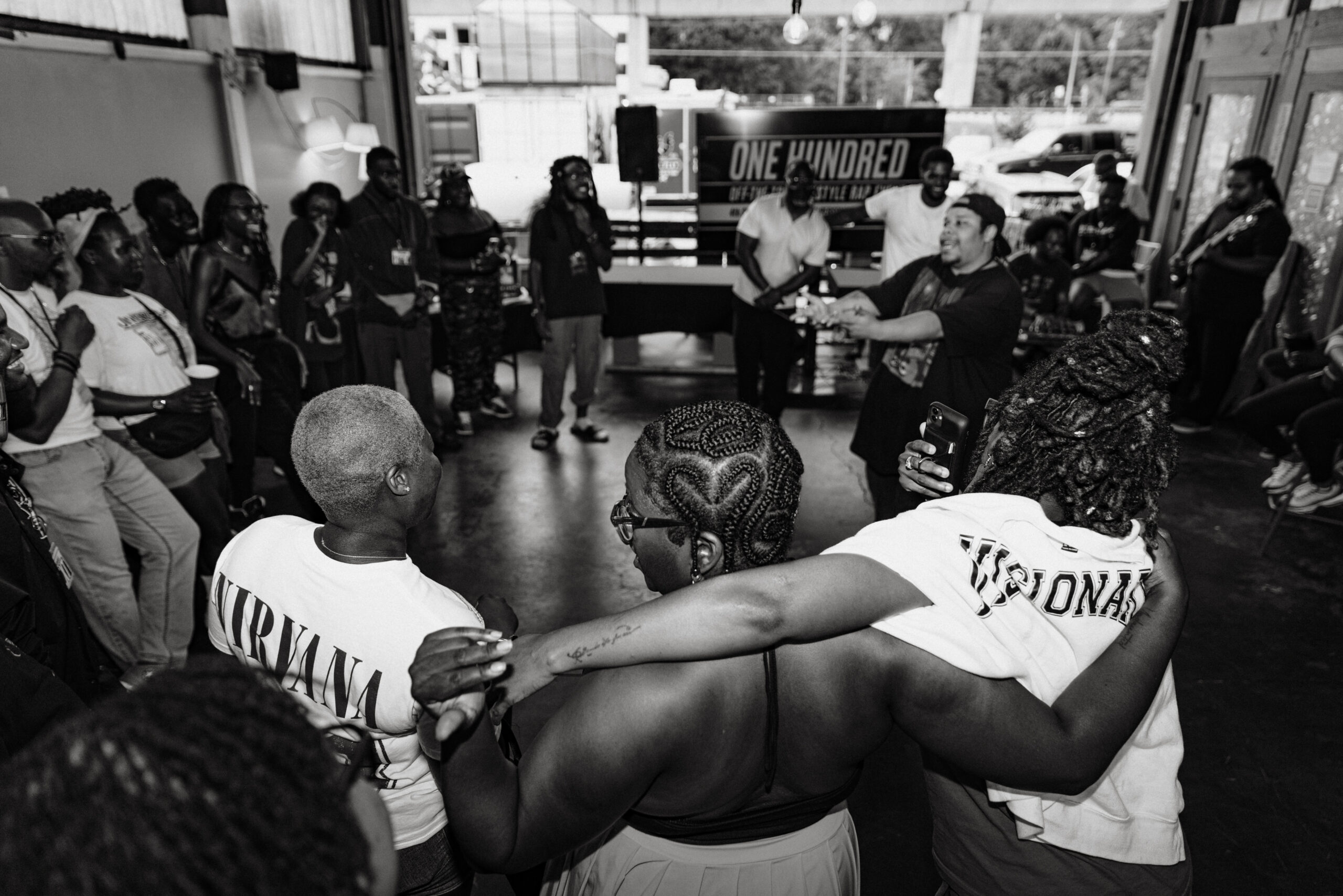
There’s absolutely a place in hip-hop for traditional battles. They challenge MCs to show and prove, to perform under pressure, and to demonstrate lyrical dominance. But the cypher isn’t about destroying your competition. It’s about building with one another. It’s a space for friendly competition, collaboration and momentum. While battles are often one-on-one, the cypher is collective, three to twenty-plus MCs forming a circle, exchanging lines and pushing each other to new heights.
Another key difference is the approach. Modern battle rap tends to be written, with MCs preparing lines ahead of time – more like a cappella poetry. In the cypher, it’s all off the top. MCs have no idea what instrumental is coming next. They have to adapt in real time, shifting their cadence, tone and delivery to meet the moment. That spontaneity makes each cypher unique, electric and honest.
There’s also a deep sense of community dialogue. Our events feel less like competitions and more like gatherings. There’s laughter, real expression, undeniable skill, and above all, a shared feeling that we’re part of something bigger. It’s not just about bars. It’s about belonging.
Can you share a story of a lyricist who found their voice or experienced growth through your programs?
Absolutely, and his name is Rio Nkosi. But better than me share his story, I’ll let him tell it.
What does Black Music Month mean to you personally and how does Soul Food Cypher celebrate its spirit?
Soul Food Cypher MCs stand on the shoulders of giants, drawing from the lineage of jazz musicians who carried the spirit of improvisation around the world. At a time when a one-sided narrative of Black life in America was being projected globally, these musicians offered a powerful counterpoint. Through their music, they demonstrated dignity, genius and resilience. I think of the Harlem Hellfighters, led by James Reese Europe, who introduced jazz to Europe during World War I. Their music wasn’t just for morale. It was a force of culture, a way to bring beauty, spirit, and hope into the chaos of war.
And then there’s Art Blakey and the Jazz Messengers in the post–World War II era. They traveled the globe, using music as a bridge across cultures. In many ways, their work was an arm of the civil rights movement, an effort to reframe how the world saw Black men. Whether through integrated bands or international tours, Blakey and others were showing the world that Blackness was not just resistance, it was brilliance, discipline and creative power. That’s the tradition Soul Food Cypher continues.
Looking ahead, what are your dreams for Soul Food Cypher, and for the next generation of lyricists?
I see Soul Food Cypher becoming to Atlanta what Preservation Hall is to New Orleans: a living institution dedicated to the tradition, evolution and excellence of freestyle rap. I envision us one day taking over a historic space—maybe even an old church—and transforming it into a permanent home and creative sanctuary for MCs.
I see us continuing as a beacon and destination for the craft, training the next generation of lyricists much like Art Blakey and the Jazz Messengers did with jazz: preparing artists to tour, perform and lead. We’ll be an incubator where MCs grow not just as performers, but as cultural workers, educators and global ambassadors.
Our educational programming will serve as a national model for culturally relevant learning, showing how freestyle can engage minds and build skills. I even see our MCs going on to earn advanced degrees, become professors of hip-hop culture, or step into classrooms as educators in their own right. Many already are educators, as we have teachers, principals and mentors among our staff and board.
We also hope to continue building bridges internationally. Last year, we held our first international cypher in Marseille, France, at the invitation of the French Consulate. That experience affirmed what we’ve always believed: this culture resonates far beyond borders. We look forward to connecting with Canada, the Caribbean, other parts of Europe, and of course, Africa, taking the art all the way back to its roots.
More than anything, I see us continuing to create space—for voice, for growth and for legacy.
Learn more about Soul Food Cypher and upcoming cyphers on its website.
Photo credit: Dustin Chambers
Categories
- Arts, Culture and Creative Enterprises14
- Book Club26
- Community110
- COVID-1934
- Donor Stories57
- Events32
- Great Grant Stories65
- Higher Ground169
- Housing and Neighborhoods30
- Impact Investing38
- Income and Wealth20
- Media22
- News163
- Nonprofits39
- Philanthropic Resources184
- Place-focused8
- Power and Leadership9
- Press Releases100
- Publications87
- TogetherATL27
- Uncategorized426